

Microsoft 365 Email and Outlook Support for Healthcare
Email is still one of the biggest day to day risks for healthcare teams. A single convincing message can lead to credential theft, mailbox access, and disruption across bookings, clinical communication, and back-office workflows. At the same time, clinics rely on Outlook and Microsoft 365 email constantly, so “security” only works if it fits how staff actually work.
Rend supports Microsoft 365 email and Outlook for healthcare practices in Australia. We help you configure secure sign-in, protect accounts, and reduce phishing exposure while keeping email reliable and easy for staff to use. The goal is simple: fewer compromised accounts, fewer interruptions, and faster response when something looks wrong.
Get in touchRend supports Microsoft 365 email and Outlook for healthcare practices in Australia. We help you configure secure sign-in, protect accounts, and reduce phishing exposure while keeping email reliable and easy for staff to use. The goal is simple: fewer compromised accounts, fewer interruptions, and faster response when something looks wrong.
Services
Explore our comprehensive service offerings
Dark Web Monitoring
Enterprise Backup & Archiving
Microsoft 365 for Healthcare
Medical Practice IT Setup & New Clinic Fit-Out
After‑hours support that prioritises clinical impact, fast triage, escalation and restoration.
Get in touch


Why Rend
Rend improves secure email for healthcare by focusing on the risks that cause real disruption, especially phishing and account takeover. We strengthen account protections, reduce unsafe handling patterns, and help clinics respond quickly when suspicious activity appears. Email stays usable for staff while security improves behind the scenes
Dedicated Support
Security & Control
End-to-end Service
Compliance
Email security and Outlook support that fits real clinic workflows
We start with the fundamentals that prevent the most common incidents. That includes secure sign-in and account protection for Microsoft 365, plus configuration that reduces the chance of credential theft and mailbox takeover. We also help tighten sharing and handling behaviours so sensitive information is less likely to be exposed through misaddressed emails, uncontrolled forwarding, or risky external sharing.
Because incidents can still happen, we build response readiness into the way email is supported. We help clinics establish a simple process for reporting suspicious messages, triaging what matters quickly, and containing account issues before they spread into files, contacts, internal messages, or financial risk.
Finally, we connect email security to the rest of your risk controls. Awareness campaigns reduce risky clicks, dark web monitoring helps you catch exposed credentials early, and backup and archiving supports continuity if accounts or data need to be restored after an incident.
Because incidents can still happen, we build response readiness into the way email is supported. We help clinics establish a simple process for reporting suspicious messages, triaging what matters quickly, and containing account issues before they spread into files, contacts, internal messages, or financial risk.
Finally, we connect email security to the rest of your risk controls. Awareness campaigns reduce risky clicks, dark web monitoring helps you catch exposed credentials early, and backup and archiving supports continuity if accounts or data need to be restored after an incident.
Achieve IT operational excellence with Rend
If you want to improve reliability, reduce downtime, or get clear advice on next steps, contact Rend for a quick consult.
Get Started
Email protection that targets the real risks
Clinic email risk is rarely theoretical. It usually shows up as phishing, credential theft, mailbox access, or account takeover that disrupts operations. Rend strengthens email security by hardening Microsoft 365 accounts, reducing unsafe handling patterns, and improving detection and response so issues are contained early and don’t repeat.
We also focus on staff behaviour because that is where email risk becomes real. A secure configuration still needs clear reporting pathways and simple habits that staff can follow under pressure. When controls and behaviour work together, clinics see fewer repeat incidents and less disruption over time.
We also focus on staff behaviour because that is where email risk becomes real. A secure configuration still needs clear reporting pathways and simple habits that staff can follow under pressure. When controls and behaviour work together, clinics see fewer repeat incidents and less disruption over time.


Testimonials
"Rend transformed our healthcare clinic's IT infrastructure completely. Their team understood our unique challenges and delivered solutions that exceeded our expectations. Patient data security and system uptime have never been better."

Lloyd Adams
Head of Growth - Genea Fertility
Rend Tech has supported Walker Street Doctors for many years. They were enormously helpful in setting up our systems in a way that were user friendly for our practice including remote access.
The systems that Rend Tech had in place protected us from a potential data breach in 2020, and saved the reputation of our practice from going the way of Optus or Medibank. They run online programs for GP owners and managers in cybersecurity. They helped guide us in our cybersecurity policy that we ask our staff to review annually.
Rend Tech recently helped us with our move to new premises. The move was seamless and expertly carried out with the bare minimum of business hours lost. Rend Tech are worth their weight in gold !.

Dr. Nerida McDonald
Principal GP & Founder
"Rend made our transition from Medical Director to Best Practice seamless and stress-free. Our systems were slow and holding us back, but their team not only uplifted our entire IT environment, they managed every aspect of the migration with precision. From conducting multiple trial conversions to working closely with our leadership team, Best Practice, and our third-party software vendors, everything was meticulously planned. The final migration was completed over the weekend, meaning we experienced zero downtime and were fully operational from day one. It truly felt like business as usual for our clinicians and staff, and we couldn’t be happier with the outcome."

Dr. Susan Culhane
Principal GP & Practice Partner
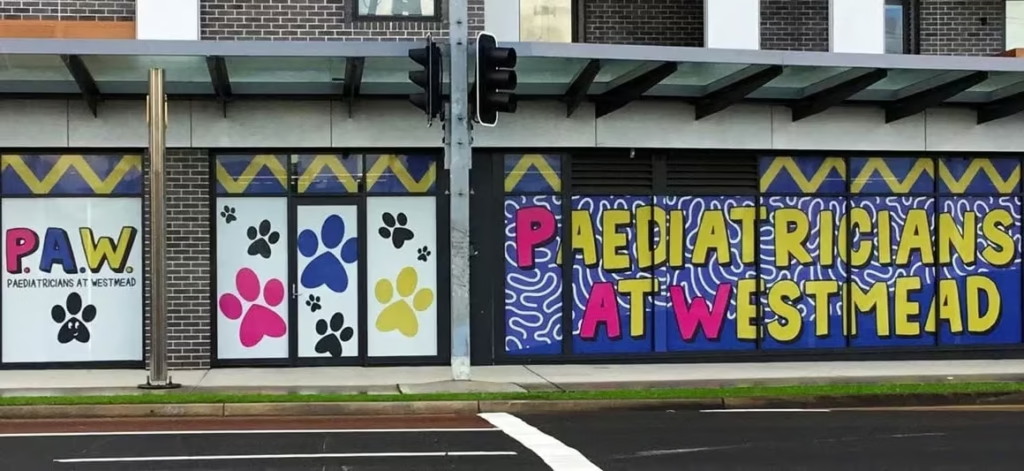
“REND Tech delivered a seamless IT rollout for The Paediatrics Practice, ensuring our systems were fully operational from day one. From network and cloud infrastructure to clinical application setup and security, everything was implemented with precision and aligned to our workflows. Our go-live was truly ‘business as usual’— with zero downtime, no data issues, and immediate access for all users. The planning, coordination with vendors, and attention to detail meant we could focus entirely on patient care from the moment we opened our doors.”

Dr Joe Meredith
Principal Specialist
Frequently asked questions
Find answers to your questions about our email solutions.
Still have questions?
We're here to help you!
Can you reduce phishing risk without blocking legitimate email?
Yes. We prioritise controls that reduce risk while maintaining usability and workflow continuity in Outlook and Microsoft 365.
What’s the most common clinic email risk?
Credential theft and account takeover are common drivers of disruption because they can quickly spread across email, files, and internal communications.
Do you support email incidents?
Yes. We help triage, contain and remediate email-related incidents, then strengthen controls and processes to reduce recurrence.
Does the email need to be encrypted at rest and in transit?
Yes. PHI must be protected while it is being sent (in transit) and while it is stored on servers (at rest).
Is Outlook automatically compliant?
No. While Microsoft 365 can be configured for compliance, it is not compliant "out of the box." You must configure them correctly, enable encryption, and sign a BAA.